

You need training content built, and your internal team is either too small, too busy, or too specialized in the wrong areas to create it. So you start searching for e-learning content development companies and immediately discover that every provider claims to be “innovative,” every platform promises “engaging” content, and none of them make it easy to figure out what they actually do differently.
Let me save you some time. These eight companies fall into three categories, and knowing which category you need narrows the field quickly.
Authoring tools give your team the software to build courses themselves. Best if you have instructional designers on staff and want control over content creation.
Full-service providers design and build custom training for you. Best if you need specific programs built but don’t have the internal capacity to create them.
Content libraries provide ready-made courses you can deploy immediately. Best if you need broad coverage quickly without custom development.
Some companies span multiple categories. I’ve noted where each one sits so you can match the provider to your actual need.
Authoring tools: build your own courses
1. Articulate
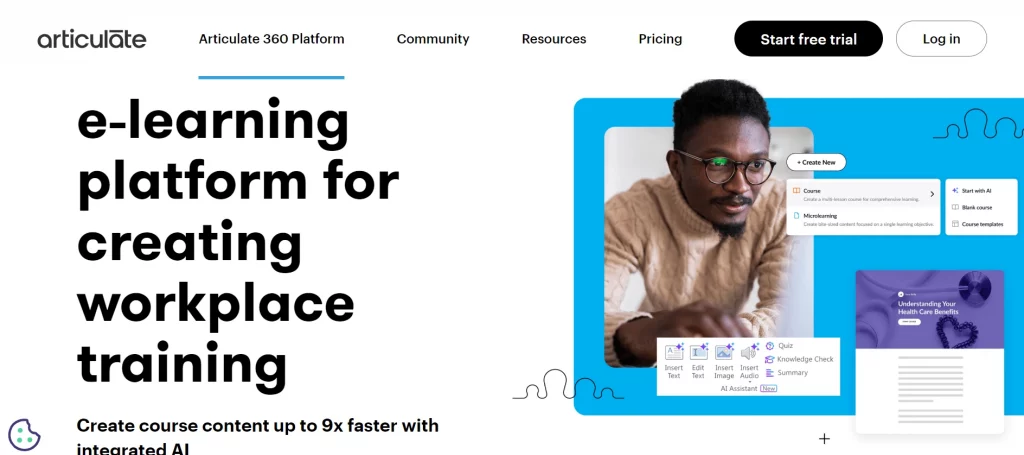
Articulate is the industry standard for e-learning authoring. Storyline handles complex interactive content, Rise handles responsive courses that work across devices. If your team creates training content regularly, you’ve probably already used one of these.
What it does well:
- Creates visually polished, interactive courses without heavy technical skills
- Speeds up content production compared to building from scratch
- Supports in-person, online, and blended formats
- Large community and template library means you’re rarely starting from zero
Where it falls short: Storyline has a steeper learning curve than Rise. If your content needs are simple, the full suite might be more tool than you need. Pricing can add up with multiple authors.
Best for: L&D teams with at least one instructional designer who creates courses regularly.
2. Adobe Captivate
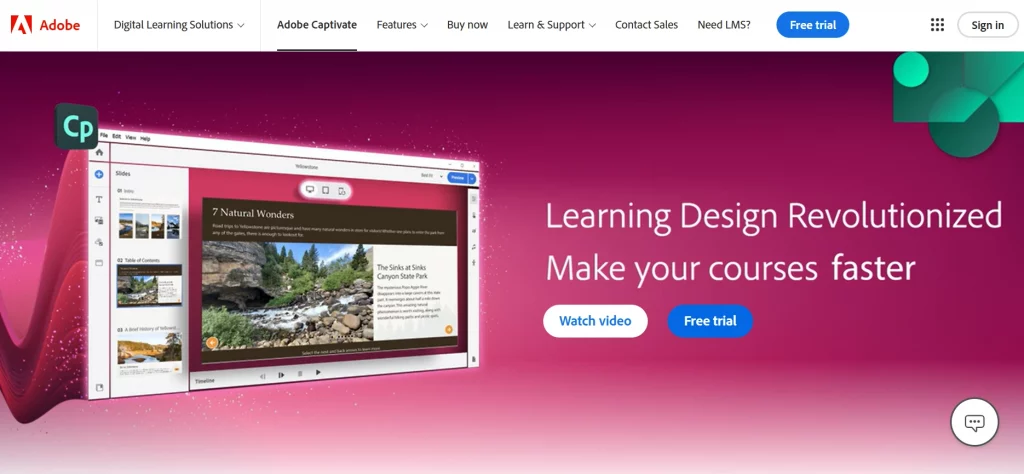
Adobe Captivate competes directly with Articulate, with particular strength in responsive design and screen recording for software training.
What it does well:
- Screen recording and software simulation creation is best-in-class
- Interactive quizzes and branching scenarios
- Responsive content that adapts to any device automatically
- Integrates with the broader Adobe ecosystem
Where it falls short: The interface can feel dated compared to newer tools. Learning curve is significant for non-technical users. Not as strong for narrative-driven content.
Best for: Teams that need software training simulations or already use Adobe products extensively.
3. Lectora
Lectora positions itself as a more accessible authoring tool, with emphasis on fast development cycles.
What it does well:
- Intuitive interface that reduces the learning curve for new authors
- Responsive course creation with less technical overhead
- Adapts quickly to changing training needs through streamlined workflows
Where it falls short: Smaller community and template library compared to Articulate. Less suited for highly complex interactive content.
Best for: Teams that need to produce courses quickly without extensive authoring experience.
Full-service providers: someone builds it for you
4. Allen Interactions
Allen Interactions is a custom e-learning development shop that emphasizes storytelling and real-world scenario design.
What it does well:
- Creates narrative-driven learning experiences that feel less like “training” and more like problem-solving
- Strong instructional design methodology (CCAF: Context, Challenge, Activity, Feedback)
- Proven track record in regulated industries where training must meet compliance standards
Where it falls short: Custom development means custom pricing, which isn’t always transparent. Longer timelines than off-the-shelf solutions.
Best for: Organizations that need high-quality custom training programs, especially in industries where engagement and compliance both matter.
5. Infopro Learning
Infopro Learning offers end-to-end learning solutions, from instructional design to LMS setup to ongoing content management.
What it does well:
- Covers the full spectrum: strategy, design, development, delivery, and measurement
- Customizes content to specific organizational goals and industry contexts
- Manages the technical side (LMS setup, integration) alongside content creation
Where it falls short: The comprehensive approach means higher costs and longer onboarding. Better suited for large-scale initiatives than small projects.
Best for: Large organizations that need a single partner for a complete training and development program, from design through delivery.
6. Cognixia
Cognixia specializes in technology-focused training, particularly in areas like data science, cloud computing, and digital skills.
What it does well:
- Deep expertise in technical and digital skill areas
- Curriculum stays current with rapidly changing technology fields
- Practical, hands-on training that goes beyond theory
Where it falls short: Narrower focus means it’s not the right partner for leadership development, compliance, or non-technical training. Less suited for custom content outside their specialty areas.
Best for: Organizations with specific technical upskilling needs in data science, cloud, DevOps, or digital transformation.
7. Kineo
Kineo specializes in custom learning solutions with a focus on blended learning that combines digital content with instructor-led components.

What it does well:
- Blended learning design that integrates e-learning with in-person sessions
- Customizes for specific industry challenges rather than applying a generic template
- Strong in both creative design and instructional rigor
Where it falls short: Custom work requires longer timelines and budget. Less suited for organizations that need a quick, off-the-shelf solution.
Best for: Organizations that want a cohesive blend of digital and in-person training, designed as a unified program rather than separate tracks.
Content libraries: ready-made courses at scale
8. Skillsoft
Skillsoft maintains one of the largest libraries of online learning content, covering everything from technical skills to leadership to compliance.
What it does well:
- Massive content library covering thousands of topics across roles and industries
- Accessible anytime, anywhere, which supports self-paced and on-demand learning
- Covers both technical skills (certifications, IT) and soft skills (leadership, communication)
Where it falls short: Off-the-shelf content can feel generic. Less effective for organization-specific training or niche topics. Courses may not match your company’s voice or culture.
Best for: Organizations that need broad coverage across many topics and want to supplement custom content with a ready-made library.
How to choose the right partner
The right choice depends on three factors:
What you’re building. If you need custom courses unique to your organization, you need either an authoring tool (plus the staff to use it) or a full-service provider. If you need broad access to existing content, a library provider works.
Your internal capacity. Teams with instructional designers get more value from authoring tools. Teams without design expertise need a full-service partner. This is similar to the L&D outsourcing decision: keep strategy in-house, outsource production where it makes sense.
Your budget and timeline. Authoring tools cost less but require staff time. Full-service providers cost more but deliver faster (assuming you’ve planned well). Libraries offer the quickest access at a per-user cost.
| Your Situation | Best Option | Why |
|---|---|---|
| Have designers, ongoing content needs | Authoring tools (Articulate, Adobe, Lectora) | Control and cost efficiency over time |
| Need a specific program built | Full-service (Allen, Infopro, Cognixia, Kineo) | Expertise and bandwidth you don’t have |
| Need broad content access now | Content library (Skillsoft) | Speed and coverage |
| Need leadership coaching, not courses | AI coaching (Risely) | Behavior change requires practice, not content |
That last row is worth noting. A coaching observation I keep coming back to: many L&D teams default to “we need a course” when the actual problem is “people know what to do but aren’t doing it.” Content solves knowledge gaps. Coaching solves application gaps. AI coaching tools like Risely’s Merlin fill a different need than any content development company, and recognizing which gap you’re facing saves you from building courses that look great but don’t change behavior.
What to check before signing a contract
Regardless of which type of provider you choose, verify these before committing:
- Ask for samples from your industry. Generic demos don’t tell you if they understand your learners.
- Clarify IP ownership. Who owns the content after the engagement? Can you modify it without their involvement?
- Understand the revision process. How many rounds of revision are included? What’s the cost and timeline for changes?
- Check integration requirements. Will the content work with your existing LMS? What format do they deliver in? (SCORM, xAPI, or proprietary)
- Request references from similar-sized clients. A provider that excels with Fortune 500 companies may not be the right fit for a 200-person organization, and vice versa.
The e-learning content market has more options than ever. The organizations that get the best results aren’t the ones who pick the “best” provider. They’re the ones who accurately diagnose whether they need a tool, a partner, or a library, and then pick the right one for that specific need.
Do a skills gap analysis first. Then pick the solution that addresses the actual gap, not the one with the most impressive demo.