


Most managers we meet are working hard. They are in meetings all day, their Slack is a fire hose, and their calendars are stacked through Friday. When we run 360 feedback for their teams, the scores tell a different story. The manager is busy. The team is not better off.
That gap, between what a manager does and what the team actually feels, is what manager effectiveness is really about.
I’ve coached over 300 managers in my work as founder of Risely, and before that as a corporate strategist. The pattern is consistent: effectiveness is not about doing more. It is about doing the right things in a way your team can actually use. This guide breaks down what those things are, how to measure them, and what to work on first.
What is manager effectiveness, really?
Manager effectiveness is the measurable impact a manager has on their team over time. It shows up in three places:
- Output: Does the team ship work that matters, on time, at a quality the business needs?
- Engagement: Do people want to stay, contribute, and raise their hand for hard problems?
- Growth: Are individual team members measurably better 12 months in than they were at the start?
If all three are moving in the right direction, the manager is effective. If only one is, something is off. A manager whose team hits numbers but burns out is not effective. Neither is one whose team is happy but drifts against goals.
Team management is the operational half of this. Effectiveness is the outcome.
What does an effective manager actually look like?
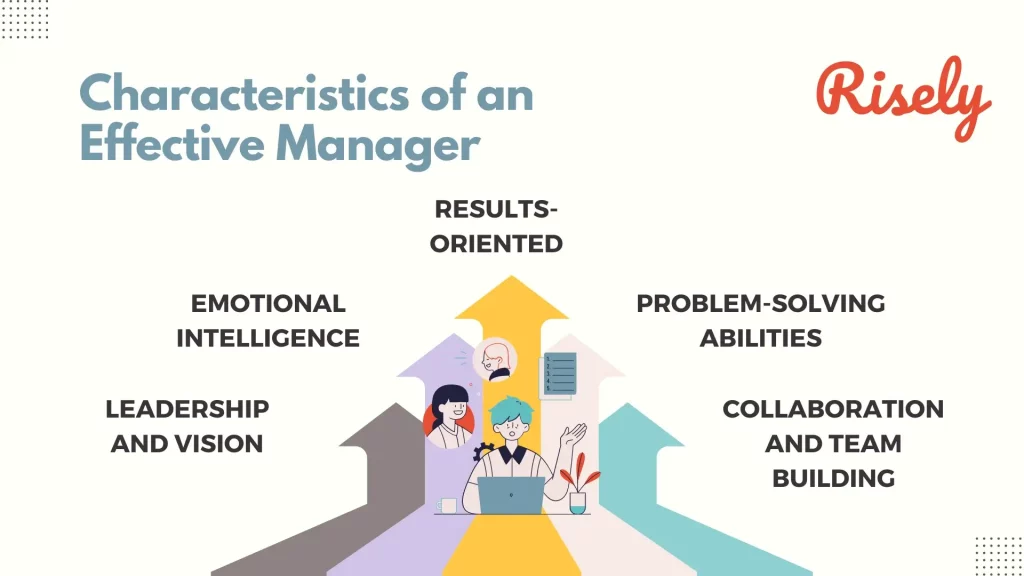
Strip away the frameworks, and effective managers share five observable behaviors. Not personality traits. Behaviors you can watch in a one-on-one or a team meeting.
- They point at a clear target. Their team can tell you, in one sentence, what they are trying to win this quarter and why it matters.
- They build the room, not just the plan. People on their teams trust each other enough to disagree in public and still walk out friends.
- They finish what they start. They do not confuse activity with progress. Projects close. Decisions stick.
- They read the room before they speak. They notice when someone is frustrated, distracted, or overwhelmed, and they do something about it before it shows up in the work.
- They solve problems with the team, not for the team. Their instinct in a crisis is to pull people in, not rescue.
Notice what is not on that list: charisma, years of experience, technical brilliance, extroversion. In our coaching work, we’ve watched quiet, introverted engineers become excellent managers and watched charismatic senior leaders fail at it. The behaviors above are learnable. Charisma is not a prerequisite.
Why does manager effectiveness matter so much right now?
Three things have changed in the last few years that make this harder, and more important.
First, teams are distributed. You cannot lean on hallway context and casual presence to stay connected. Whatever your management style is, it has to work on a screen, often across time zones.
Second, the gap between a great manager and a mediocre one compounds faster. When work is knowledge-heavy and interdependent, a week of bad direction from a manager costs the team two weeks of rework.
Third, people leave managers, not companies. That is not a new cliche. What is new is the speed. In our data across 40+ organizations, the strongest predictor of a high performer’s exit within 12 months is their confidence in their direct manager.
Effectiveness is no longer a nice-to-have leadership quality. It is the unit economics of your team.
What are the core skills of an effective manager?
Across the field and in our own coaching data, four skills come up more than the rest. Almost everything else is built on top of these.
1. Guidance: can you make the work clear?
This is the ability to translate strategy into specific direction a person can act on tomorrow morning. Not vision speeches. Concrete answers to: “What am I doing, why does it matter, and how will we know it worked?”
Most managers think they give clear direction. Almost none do. A useful test: ask three of your direct reports, separately, what the team’s top priority is this quarter. If you get three different answers, the problem is not your team. It is your guidance.
Strong guidance also means course-correcting early. Waiting until quarter-end to tell someone they missed the target is a post-mortem dressed up as feedback.
2. Emotional regulation: can you stay level when the team is not?
Emotional competence does not mean being nice or always calm. It means not adding your emotional state to the team’s problem. When a release breaks, a major client threatens to leave, or a board meeting goes sideways, an effective manager absorbs some of the stress rather than multiplying it.
We coached a VP of engineering at a Series C SaaS company last year, Sarah, whose team was highly technical and consistently on time. Her 360 scores were terrible. The pattern we found: in crises, her anxiety would spike and she’d start micromanaging. Her team learned to hide problems from her because surfacing them meant two weeks of overhead.
The work moved faster when she didn’t know about it. That is an effectiveness problem, even when the output looks fine.
3. Analytical thinking: can you decide with incomplete information?
Managers get paid to make calls when the data is 60% there. What trips people up is either rushing (deciding before the real question is in view) or freezing (collecting data until the moment has passed).
Good analytical thinking as a manager is less about intelligence and more about discipline. You learn to ask: What is the decision I actually need to make? What information would change it? What is the cost of being wrong, and is it recoverable?
4. Interpersonal range: can you flex across different people?
This is the ability to communicate with a senior designer and a first-week intern and have both walk away clear on what’s next. The generic label is “people skills.” What it actually means is adjusting your approach (tone, detail level, directness) to the person in front of you.
A common failure mode we see: managers default to the communication style they themselves respond to. A manager who likes direct feedback gives direct feedback to everyone, including the person who needs it delivered differently. That is not authenticity. That is a range problem.
Effective vs ineffective manager behaviors
After running 5,000+ coaching conversations and 360s, we can predict within a few weeks which managers are landing with their teams and which are not. The differences tend to show up here:
| Situation | Ineffective manager | Effective manager |
|---|---|---|
| A team member misses a deadline | Sends a Slack: “What happened?” at 5pm Friday | Checks in mid-week when they see the risk, asks what’s blocking |
| The team disagrees on priorities | Picks the loudest voice or avoids the call | Surfaces the tradeoff explicitly, makes the call, explains why |
| A direct report gives critical feedback | Gets defensive or quiet, circles back days later | Says “tell me more” in the moment, acts on it within two weeks |
| A cross-functional partner blocks progress | Escalates to their own manager | Goes direct, frames it as a shared problem, brings options |
| Performance is slipping for a senior team member | Avoids the conversation until review cycle | Raises it in the next one-on-one, specifically, with examples |
| Team morale drops | Schedules a happy hour or survey | Has three one-on-ones asking “what’s draining you right now” |
| A mistake happens publicly | Finds someone to blame or over-explains | Owns it, separates the error from the person, moves to fix |
| Onboarding a new hire | Hands them a doc and a calendar invite | Maps the first 90 days with them, checks in weekly |
None of the “effective” column is complicated. All of it requires choosing the harder conversation in the moment. That is what management muscle actually is.
What about planning, delegation, coaching, and conflict?
These get listed in every manager skills article, and they matter. But they rest on the four core skills above. If you can give clear direction and regulate your own state, you can learn to delegate. If you cannot, no delegation framework will save you.
Planning
Planning is the operational output of the guidance skill. An effective manager’s plan answers three questions: what are we doing this quarter, in what order, and what are we explicitly not doing. The third question is the one most skipped. See strategic thinking vs strategic planning for the difference that matters most.
Coaching
Coaching is the extension of guidance into someone’s growth, not just their output. The shift is from “do this task” to “what’s the skill you’re building through this task.” Managers who coach well tend to ask more than they tell. For most new managers, the ratio flips the wrong way. See our guide on coaching as a manager skill.
Delegation
Delegation fails when managers hand off tasks without context, or when they hover after handing off. The art of delegation is learning which parts of a job to keep (usually the first conversation, the hard judgment call, and the final review) and which to release.
Conflict management
Conflict is where emotional regulation and interpersonal range meet. Our rule with managers we coach: name the conflict before the second time it shows up. If two team members clashed in a meeting once, watch. If it happens twice, say it out loud.
Most managers wait until the fourth or fifth occurrence, by which point the team has already absorbed it as culture. See conflict resolution at work for structured approaches.
Trust
Trust is not a skill you build directly. It is the residue of the other four, applied consistently. You cannot earn trust by doing “trust-building activities.” You earn it by being predictable: people on your team know what you’ll do when things go wrong, and they know your feedback in private matches your praise in public.
How do you measure manager effectiveness?
One metric will lie to you. The combination is harder to fake.
- Team engagement (trend, not point): Running a pulse every quarter and watching the direction matters more than any single score. If a manager inherits a 3/5 and moves it to 4/5 over three quarters, that is effectiveness. A stable 4.5 that was handed to them is not necessarily.
- Retention of high performers: Losing a low performer may be fine. Losing your best engineer to a competitor is a signal.
- Goal attainment rate: Not just whether goals hit, but whether they were the right goals. An effective manager catches mis-scoped goals mid-cycle, not at the review.
- Direct report growth: Promotions, skill progression, internal mobility. If nobody on a manager’s team has grown in 18 months, the team is a plateau.
- 360 feedback, specifically the “upward” view: Peers overestimate managers. Bosses miss a lot. The direct reports see the most. Their feedback, collected well, is the highest signal.
The trap to avoid: measuring activity (meetings held, one-on-ones scheduled, tasks delegated) instead of outcomes. A manager can hold perfect one-on-ones every week and still be ineffective if the content of those meetings is status updates instead of coaching.
For a structured self-assessment, we built a free leadership assessment that takes about 10 minutes and benchmarks you across 12 manager-specific skills. It is the same structure we use with our coaching cohorts.
A coaching scene: what shifting actually looks like
A pattern we see often: a manager, call her Rachel, runs a 14-person marketing team. Her output is strong, her team is working hard, but two of her best people have quit in the last eight months and her engagement scores dropped 15 points. She is furious with herself but cannot see the pattern.
In the first coaching session, we ask her to walk through her last five one-on-ones from memory. She can recall every project detail she discussed. She cannot recall a single thing she learned about the person. Not one.
That is the effectiveness gap in one data point. Her one-on-ones had become status meetings. Her team did not feel known. They felt managed.
The fix was not complicated. We had her start every one-on-one with one question that was not about work, and spend five minutes actually listening. Four weeks in, her next pulse showed a meaningful shift. By week 10, one of her senior people told her directly: “You seem like you want to be here now.”
She had always wanted to be there. The team just couldn’t feel it before.
How does a manager actually get better?
This is the question every manager we coach asks in session one. The honest answer is mechanical, not inspirational.
- Pick one behavior, not ten. The most common failure mode is trying to fix everything. Choose the single thing your team would benefit from most. For most managers, this is either “give clearer direction” or “give harder feedback.”
- Make it specific. “Give clearer direction” is useless. “At the end of every project kickoff, ask each person to tell me in their own words what they’re doing and why” is a behavior you can practice.
- Run it for four weeks. Change does not happen in a day. Run the new behavior through at least four weeks of normal work to see what sticks.
- Ask the team. At week four, ask three people on your team whether they’ve noticed a change. If they have not, the behavior did not land. Either it was too subtle or you did not do it consistently.
- Pick the next one. Compounding matters more than intensity. One behavior changed every quarter is four new habits a year. That is a different manager.
This is also why books and generic courses tend not to move the needle. They give you thirty things to work on. Nobody changes thirty things at once.
If you want a structured way to do this, our coaching assessment surfaces the specific behavior to start with based on your current profile. It is built on our skill framework covering 83 assessable skills.
What tools and systems actually help?
We are careful here because most “manager tools” lists confuse software with effectiveness. Software helps. It does not substitute for the skills.
- A one-on-one template that is not a status update. Three sections: what’s on your mind, what I’m seeing, what we’ll do next. See our guide on running one-on-one meetings.
- A weekly team ritual that is not a meeting. A shared doc, async check-in, or retro cadence. Meetings are not the only way to run a team.
- A written feedback system. Verbal feedback disappears. Written feedback, delivered well, sticks. Most managers need a standard structure to practice.
- A calendar block for thinking. If every hour of your week is defensive (reacting to others), you cannot plan. Effective managers block 2-4 hours a week for strategic thinking, not optionally.
- A development plan per direct report, reviewed quarterly. Not a performance review. A forward-looking plan on what they want to grow into.
At Risely, we run this stack with Merlin, our AI coach, embedded in Slack and Teams. But the tools are useful whether you use us or build them yourself. What matters is that the system exists and is maintained.
Performance goals that actually drive effectiveness
Most manager performance goals are activity-based (hold X one-on-ones, complete Y training). The better goals are outcome-based:
- Engagement trend: Improve team pulse by 10 points over 2 quarters, measured against a baseline.
- Feedback cadence: Deliver written, specific feedback to each direct report monthly, with reflection on whether the feedback changed behavior.
- Goal clarity: By end of quarter, every direct report can state, unprompted, what the team is trying to win and why.
- Talent development: At least one direct report progresses to the next level or takes on a stretch scope within 12 months.
- Retention of high performers: Zero regretted attrition on the A-player roster over the year.
Notice how these force attention to the team, not to the manager’s own activity. That is the difference between effectiveness goals and busy-work goals.
Time management for effective managers
You cannot be an effective manager if your calendar owns you. Most new managers we coach come in with 80%+ of their week in meetings, and spend evenings and weekends doing the actual thinking. That model breaks within 18 months.
Better productivity software will not fix it. Ruthless reduction will. See time management skills for managers for a structured approach. Short version: every recurring meeting on your calendar should justify itself quarterly. If it would not survive being cancelled, it should not run.
How is this different for new managers vs experienced ones?
New managers typically struggle with two things: separating “I did it myself” from “my team did it,” and giving hard feedback. The reflex is to take work back when a report is struggling. That reflex is the single biggest blocker to becoming effective.
Experienced managers plateau for a different reason. They built a playbook that worked for a 5-person team, and they are now leading 40 people. The skills that got them here will not get them to the next level. Effective leadership for senior managers is less about doing and more about the system they build around the work.
Both groups benefit from the same discipline: one behavior at a time, four weeks of practice, feedback from the team, move on.
How can Risely help?
Risely is a coaching platform built for the reality above. Merlin, our AI coach, sits inside Slack and Microsoft Teams and works with managers on specific behaviors, one at a time, across 83 people skills. Not a course. A daily coach in the places you already work.
If you want to see what that looks like, you can talk to Merlin for free. Or start with our manager effectiveness self-assessment to get a read on where to start. Either way, the goal is the same: less doing, more impact.
Frequently asked questions
What is manager effectiveness? Manager effectiveness is the measurable impact a manager has on their team’s output, engagement, and growth. It is not time spent in meetings or tasks assigned. It is whether the team gets clearer, faster, and better under their leadership over 6 to 12 months.
How do you measure manager effectiveness? Measure four things together: team engagement scores (trend over 2+ quarters), retention of high performers, goal attainment rate, and direct report growth (promotions, skill progression, 360 feedback). One metric alone lies. The combination tells the truth.
What are the most important skills for an effective manager? Four skills compound more than the rest: giving direction (clarity on what good looks like), emotional regulation (staying level when the team is not), analytical thinking (deciding with incomplete information), and interpersonal range (adjusting your style across different people). Everything else sits on top of these four.
Can a manager become more effective, or is it personality? Effectiveness is a skill, not a personality trait. We see managers in our coaching shift measurably in 10 to 12 weeks when they work on one concrete behavior at a time. The managers who stay stuck usually confuse busyness with impact, or treat feedback as a personal attack.
What is the fastest way to improve as a manager? Pick one behavior your team would benefit from most (usually clarity of direction or giving feedback), practice it for 4 weeks with a specific structure, then ask your team if they noticed a change. That feedback loop moves you faster than any course or book.